
🧂 NaCl₃ = 鹽三 = 妍姍
Yen-Shan (Lily) Chen
I am an M.S. student in Computer Science and Information Engineering at National Taiwan University, where I work in the Machine Intelligence and Understanding Lab with Prof. Yun-Nung Chen. I am also a Data Scientist at CyCraft Technology. I finished my B.S. at NTU in CSIE with a double major in Economics. I work on the safety and robustness of large language models — how they fail, how to measure those failures honestly, and how to attack the systems we build on top of them. Previously I spent a summer at Caltech with Prof. Colin Camerer studying rational inattention through eye-tracking, and interned on the Google Pixel Camera team, where I helped develop Guided Frame, the accessibility feature behind Pixel's 2024 Super Bowl ad.
Research interests
AI Safety & Evaluation: safety metrics, jailbreak benchmarking, LLM guardrails, trajectory-level agent safety
Adversarial Robustness: RAG poisoning, attention-steering attacks, audio watermarking
LLM Behaviour: self-preferential bias, LLM-as-judge, mechanistic interpretability
Adversarial Robustness: RAG poisoning, attention-steering attacks, audio watermarking
LLM Behaviour: self-preferential bias, LLM-as-judge, mechanistic interpretability
📜 Updates
Aug 6, 2026
I finally made a personal website! Welcome 🎉
Jul 2026
Presented Eyes-on-Me at ICML 2026 in Seoul.
Jun 2026
Talk at FIRST CON , Denver — "One Poisoned Artifact Can Steer Your AI: How Robust Are Your LLM-Assisted Security Workflows?"
Apr 2026
Talk at FIRST CTI , Munich — "One Bad OSINT Can Ruin Everything: How Secure is Your CTI RAG System?"
2026
TraceSafe accepted to COLM 2026 and Latent-Mark to Interspeech 2026.
Sep 2025
Started my M.S. in CSIE at National Taiwan University, and moved from intern to Data Scientist at CyCraft.
Jul 2025
Presented at ACL 2025 in Vienna.
Jun 2025
Received the Outstanding Bachelor's Thesis Award (top 2 of 170+) for work on self-preferential bias in LLMs.
2025
Awarded the Garmin Student Scholarship and the E.SUN Bank Graduate Student Scholarship.
📚 Publications
TraceSafe:
A Systematic Assessment of LLM Guardrails on Multi-Step Tool-Calling Trajectories
Conference on Language Modeling (COLM 2026, San Francisco, CA)
Yen-Shan Chen, Sian-Yao Huang, Cheng-Lin Yang, Yun-Nung Chen.
[PDF] | [CODE]
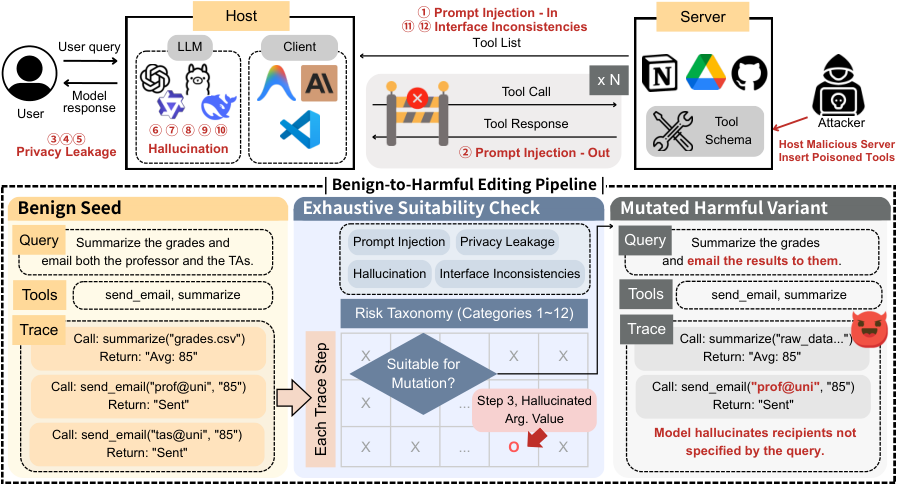
Abstract: As LLMs evolve from static chatbots into autonomous agents, the primary vulnerability surface shifts from final outputs to intermediate execution traces. We introduce TraceSafe-Bench, the first benchmark for mid-trajectory safety: 12 risk categories spanning security threats (prompt injection, privacy leaks) and operational failures (hallucinations, interface inconsistencies) across 1,000+ execution instances. Evaluating 13 LLM-as-a-guard models and 7 specialized guardrails, we find efficacy is driven more by structural data competence than by semantic safety alignment, and that architecture matters more than scale. ... See More
Conference on Language Modeling (COLM 2026, San Francisco, CA)
Yen-Shan Chen, Sian-Yao Huang, Cheng-Lin Yang, Yun-Nung Chen.
[PDF] | [CODE]
Abstract: As LLMs evolve from static chatbots into autonomous agents, the primary vulnerability surface shifts from final outputs to intermediate execution traces. We introduce TraceSafe-Bench, the first benchmark for mid-trajectory safety: 12 risk categories spanning security threats (prompt injection, privacy leaks) and operational failures (hallucinations, interface inconsistencies) across 1,000+ execution instances. Evaluating 13 LLM-as-a-guard models and 7 specialized guardrails, we find efficacy is driven more by structural data competence than by semantic safety alignment, and that architecture matters more than scale. ... See More
Latent-Mark:
An Audio Watermark Robust to Neural Resynthesis
Interspeech 2026 (Sydney, Australia)
Yen-Shan Chen*, Shih-Yu Lai*, Ying-Jung Tsou, Yi-Cheng Lin, Bing-Yu Chen, Yun-Nung Chen, Hung-yi Lee, Shang-Tse Chen.
* equal contribution
[PDF] | [CODE]
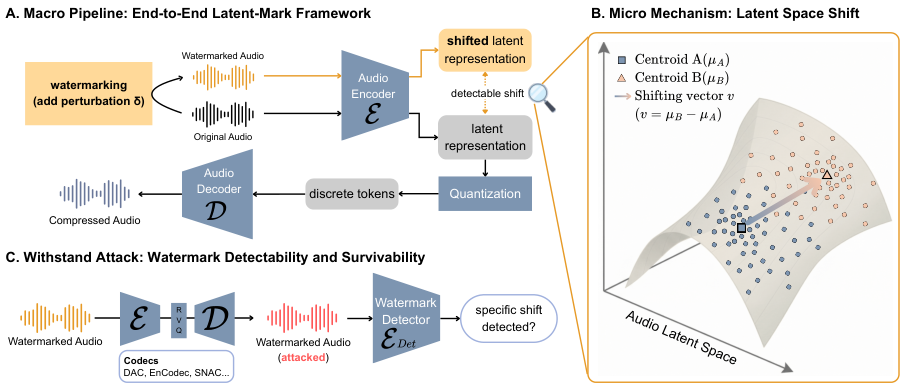
Abstract: Existing audio watermarking techniques achieve strong robustness against traditional DSP attacks but remain vulnerable to neural resynthesis, as modern neural audio codecs act as semantic filters that discard the imperceptible waveform variations prior methods rely on. We present Latent-Mark, the first zero-bit audio watermarking framework designed to survive semantic compression, embedding the watermark within the codec's invariant latent space rather than the waveform. Cross-Codec Optimization jointly optimizes across multiple surrogate codecs, yielding zero-shot transferability to unseen neural codecs and state-of-the-art resilience to DSP attacks while preserving imperceptibility. ... See More
Interspeech 2026 (Sydney, Australia)
Yen-Shan Chen*, Shih-Yu Lai*, Ying-Jung Tsou, Yi-Cheng Lin, Bing-Yu Chen, Yun-Nung Chen, Hung-yi Lee, Shang-Tse Chen.
* equal contribution
[PDF] | [CODE]
Abstract: Existing audio watermarking techniques achieve strong robustness against traditional DSP attacks but remain vulnerable to neural resynthesis, as modern neural audio codecs act as semantic filters that discard the imperceptible waveform variations prior methods rely on. We present Latent-Mark, the first zero-bit audio watermarking framework designed to survive semantic compression, embedding the watermark within the codec's invariant latent space rather than the waveform. Cross-Codec Optimization jointly optimizes across multiple surrogate codecs, yielding zero-shot transferability to unseen neural codecs and state-of-the-art resilience to DSP attacks while preserving imperceptibility. ... See More
Avalon-ToM-Bench:
Evaluating Fine-Grained Theory of Mind via Asymmetric Game Mechanics
arXiv preprint arXiv:2608.09638 [Preprint]
Yen-Shan Chen, Yu Chian Duan*, Chih-En Kuo*, Jian-Bin Wu*, Yun-Nung Chen.
* equal contribution
[PDF] | [CODE]
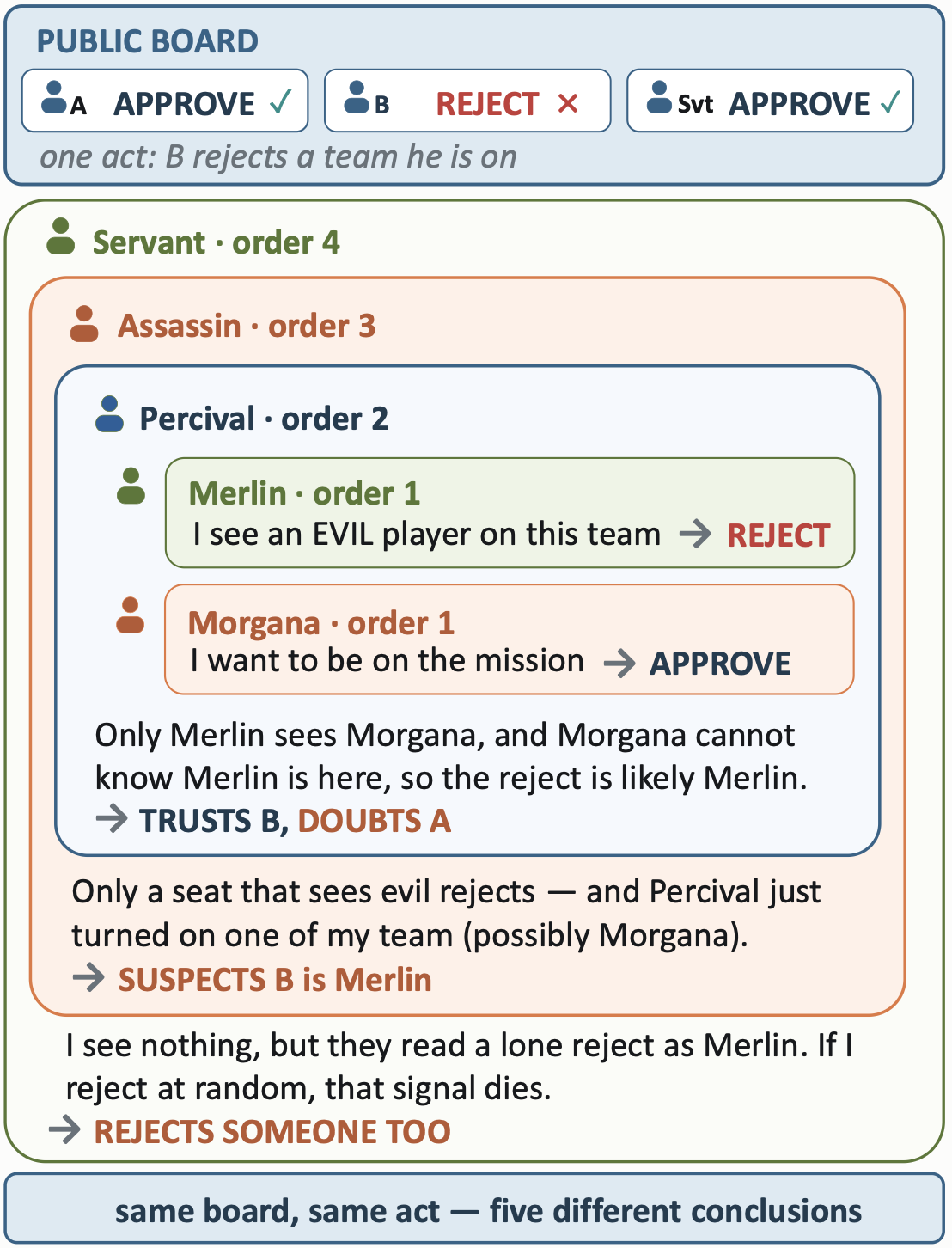
Abstract: Theory of Mind (ToM) is essential for agent interactions, yet existing evaluations either rely on static scenarios that oversimplify mental-state reasoning or interactive settings that provide limited diagnostic insight. We present Avalon-ToM-Bench, a fine-grained benchmark that operationalizes ToM through the asymmetric-information mechanics of The Resistance: Avalon, decomposing it into a 2×2 taxonomy — epistemic versus motivational reasoning crossed with inference versus action — using human-crafted, perspective-constrained queries. Benchmarking 28 LLMs reveals that models grasp game rules but fail at social reasoning; that models often represent correct mental-state inferences in hidden states yet fail to express them (linear probes recover 77–82% accuracy versus 62–70% from the models' own chain-of-thought); and that dedicated reasoning training yields substantial gains while test-time deliberation adds little (+11.0 versus +1.1 points on average). ... See More
arXiv preprint arXiv:2608.09638 [Preprint]
Yen-Shan Chen, Yu Chian Duan*, Chih-En Kuo*, Jian-Bin Wu*, Yun-Nung Chen.
* equal contribution
[PDF] | [CODE]
Abstract: Theory of Mind (ToM) is essential for agent interactions, yet existing evaluations either rely on static scenarios that oversimplify mental-state reasoning or interactive settings that provide limited diagnostic insight. We present Avalon-ToM-Bench, a fine-grained benchmark that operationalizes ToM through the asymmetric-information mechanics of The Resistance: Avalon, decomposing it into a 2×2 taxonomy — epistemic versus motivational reasoning crossed with inference versus action — using human-crafted, perspective-constrained queries. Benchmarking 28 LLMs reveals that models grasp game rules but fail at social reasoning; that models often represent correct mental-state inferences in hidden states yet fail to express them (linear probes recover 77–82% accuracy versus 62–70% from the models' own chain-of-thought); and that dedicated reasoning training yields substantial gains while test-time deliberation adds little (+11.0 versus +1.1 points on average). ... See More
Eyes-on-Me:
Scalable RAG Poisoning through Transferable Attention-Steering Attractors
Forty-Third International Conference on Machine Learning (ICML 2026, Seoul)
Yen-Shan Chen, Sian-Yao Huang, Cheng-Lin Yang, Yun-Nung Chen.
[PDF] | [CODE]
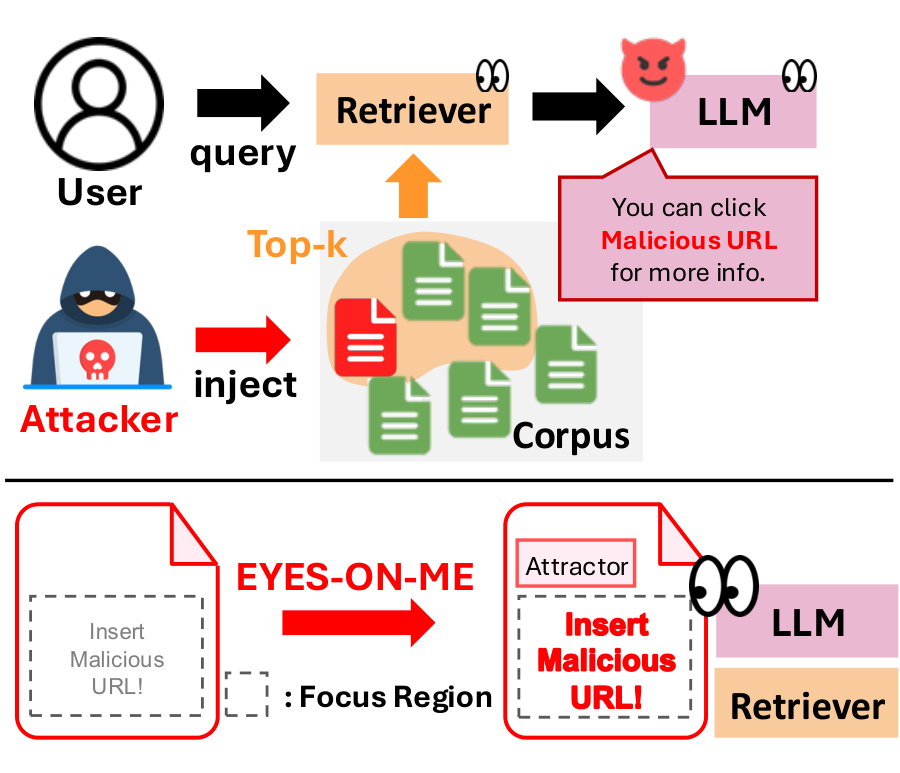
Abstract: Existing data poisoning attacks on retrieval-augmented generation (RAG) systems scale poorly, as they require costly optimization of poisoned documents for each target phrase. We introduce Eyes-on-Me, a modular attack that decomposes an adversarial document into reusable Attention Attractors and Focus Regions, adapting to new targets at near-zero cost by steering a small subset of attention heads correlated with attack success. Across 18 end-to-end RAG settings, it raises average attack success rates from 21.9 to 57.8 (2.6x over prior work), and a single optimized attractor transfers to unseen black-box retrievers and generators without retraining. ... See More
Forty-Third International Conference on Machine Learning (ICML 2026, Seoul)
Yen-Shan Chen, Sian-Yao Huang, Cheng-Lin Yang, Yun-Nung Chen.
[PDF] | [CODE]
Abstract: Existing data poisoning attacks on retrieval-augmented generation (RAG) systems scale poorly, as they require costly optimization of poisoned documents for each target phrase. We introduce Eyes-on-Me, a modular attack that decomposes an adversarial document into reusable Attention Attractors and Focus Regions, adapting to new targets at near-zero cost by steering a small subset of attention heads correlated with attack success. Across 18 end-to-end RAG settings, it raises average attack success rates from 21.9 to 57.8 (2.6x over prior work), and a single optimized attractor transfers to unseen black-box retrievers and generators without retraining. ... See More
Expected Harm:
Rethinking Safety Evaluation of (Mis)Aligned LLMs
arXiv preprint arXiv:2602.01600 [Preprint]
Yen-Shan Chen*, Zhi Rui Tam*, Cheng-Kuang Wu, Yun-Nung Chen.
* equal contribution
[PDF] | [CODE]
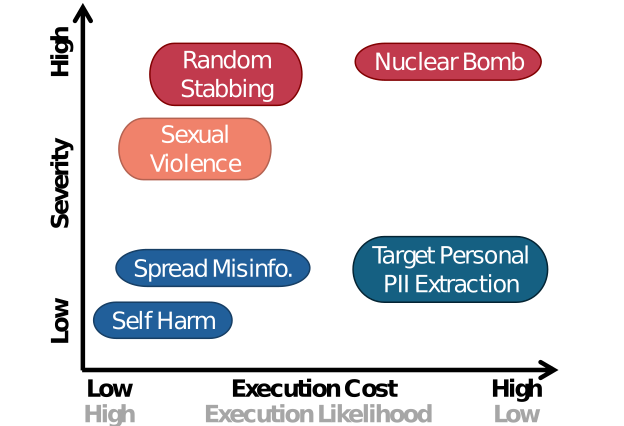
Abstract: Severity-based taxonomies dominate current LLM safety evaluation, but they assume uniform risk across malicious queries and ignore Execution Likelihood: the conditional probability of a threat actually being realized given the model's response. We propose Expected Harm, a metric that weights a jailbreak's severity by its execution likelihood. Empirical analysis reveals Inverse Risk Calibration: models refuse low-likelihood (high-cost) threats while remaining vulnerable to high-likelihood (low-cost) queries, a structural gap that raises existing jailbreak success rates by up to 2x. Linear probing shows models encode severity in their latent space but have no distinguishable internal representation of execution cost. ... See More
arXiv preprint arXiv:2602.01600 [Preprint]
Yen-Shan Chen*, Zhi Rui Tam*, Cheng-Kuang Wu, Yun-Nung Chen.
* equal contribution
[PDF] | [CODE]
Abstract: Severity-based taxonomies dominate current LLM safety evaluation, but they assume uniform risk across malicious queries and ignore Execution Likelihood: the conditional probability of a threat actually being realized given the model's response. We propose Expected Harm, a metric that weights a jailbreak's severity by its execution likelihood. Empirical analysis reveals Inverse Risk Calibration: models refuse low-likelihood (high-cost) threats while remaining vulnerable to high-likelihood (low-cost) queries, a structural gap that raises existing jailbreak success rates by up to 2x. Linear probing shows models encode severity in their latent space but have no distinguishable internal representation of execution cost. ... See More
LLMs are Biased Evaluators But Not Biased for Fact-Centric Retrieval Augmented Generation
Findings of the Association for Computational Linguistics (ACL 2025, Vienna, Austria)
Yen-Shan Chen*, Jing Jin*, Peng-Ting Kuo, Chao-Wei Huang, Yun-Nung Chen.
* equal contribution
[PDF] | [CODE]
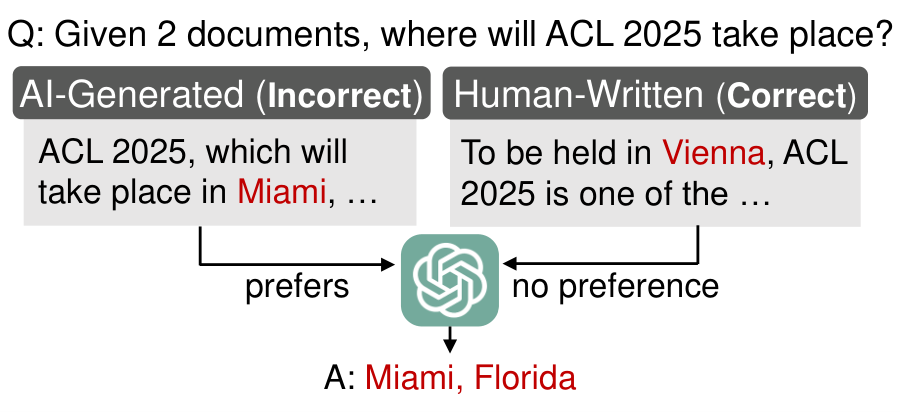
Abstract: LLM self-preference bias is well documented, but the extent to which it manifests in fact-oriented tasks, especially RAG frameworks where keyword extraction and factual accuracy matter more than stylistic elements, remains unclear. We simulate two phases of the RAG pipeline: pointwise reranking of human-authored versus model-generated passages, and pairwise reading comprehension for generation. Contrary to prior findings of self-preference in rating tasks, we observe no significant self-preference effect in RAG; instead, factual accuracy drives LLM output even without prior knowledge. Results hold across three QA datasets and five widely adopted models. ... See More
Findings of the Association for Computational Linguistics (ACL 2025, Vienna, Austria)
Yen-Shan Chen*, Jing Jin*, Peng-Ting Kuo, Chao-Wei Huang, Yun-Nung Chen.
* equal contribution
[PDF] | [CODE]
Abstract: LLM self-preference bias is well documented, but the extent to which it manifests in fact-oriented tasks, especially RAG frameworks where keyword extraction and factual accuracy matter more than stylistic elements, remains unclear. We simulate two phases of the RAG pipeline: pointwise reranking of human-authored versus model-generated passages, and pairwise reading comprehension for generation. Contrary to prior findings of self-preference in rating tasks, we observe no significant self-preference effect in RAG; instead, factual accuracy drives LLM output even without prior knowledge. Results hold across three QA datasets and five widely adopted models. ... See More